

10 Famous Ziyarat Places in Makkah
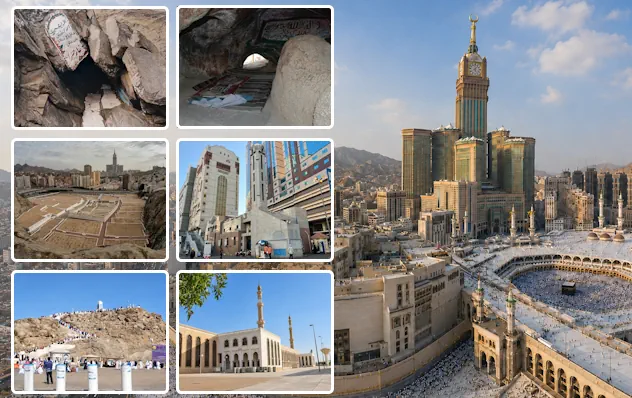
Makkah is the holiest city in Islam. It has many sacred places in its streets and nearby hills that are important to Muslims because of their history and religious significance.
Below is a clear guide to the most important places for Zayarat in Makkah.
1. Masjid al-Haram and the Holy Kaaba

Masjid al-Haram is the heart of Makkah. It is the most holy mosque in Islam. At its center stands the Holy Kaaba. Muslims around the world face the Kaaba during prayer.
Pilgrims start their Umrah here. Tawaf is done around the Kaaba. Sa’i is completed between Safa and Marwah. Maqam Ibrahim and the Black Stone are also inside the mosque.
Masjid al-Haram holds great value. A single prayer here carries more reward than prayers elsewhere. Pilgrims spend most of their time in this mosque.
2. Cave of Hira – Jabal al-Noor

The Cave of Hira is one of the most respected places in Islamic history. It is located on top of Jabal al-Noor, a well-known mountain near Makkah. This blessed cave is where Prophet Muhammad (PBUH) received the first Wahy of the Holy Quran.
The cave is small in size. It is about 12 feet long and around 5 feet wide. It is located nearly 3 kilometers away from Masjid al-Haram. Despite its size, the cave holds great meaning for Muslims across the world.
Before Prophethood, Prophet Muhammad (PBUH) often came here to spend time in quiet reflection. He would spend long hours, and sometimes days, in deep thought and worship. He would bring food and water with him so he could stay there alone without being disturbed.
The climb to the cave takes effort. The path is steep and rocky. Pilgrims visit this place to remember the beginning of Islam. Many people offer silent prayers and reflect on the moment when guidance began for mankind.
3. Cave of Thawr – Jabal Thawr

The Cave of Thawr, also known as Ghar Thawr, is a deeply respected site in Makkah. It is located on Jabal Thawr, a mountain south of the city. This cave is closely linked to the Hijrah of Prophet Muhammad (PBUH).
During the migration from Makkah to Madinah, the Prophet (PBUH) stayed in this cave for three days. He was accompanied by his close companion, Hazrat Abu Bakr (may Allah be pleased with him). They stayed here to remain safe from the Quraysh search parties. The cave is about 3 feet wide and has two entrances, one on the east side and one on the west.
According to Islamic tradition, Allah protected the Prophet Muhammad (ﷺ) and his companions. A spider formed a web across the cave entrance. When the search parties arrived, they saw the web and believed no one was inside. This act of protection allowed the Prophet (PBUH) to remain safe.
Visiting the Cave of Thawr during Makkah Zayarat reminds pilgrims of trust in Allah. It reflects patience, courage, and strong faith during times of hardship.
4. Jannatul Mualla (Jannat al-Mu’alla)

Jannatul Mualla is one of the oldest and most respected cemeteries in Makkah. It is also known as Maqbara Ma’la and Al-Hajoon. This sacred graveyard is located about one kilometer from Masjid al-Haram.
Many well-known figures from Islamic history are buried here. The most notable is Hazrat Khadijah (may Allah be pleased with her), the first wife of Prophet Muhammad (PBUH). Several other members of the Prophet’s family and his close companions are also laid to rest at this site.
Pilgrims visit Jannat al-Mu’alla as part of Makkah Zayarat to offer dua for those buried here. The atmosphere is quiet and respectful. A visit to this cemetery reminds pilgrims of the strong faith of the early Muslims and the simple nature of life in this world.
5. Masjid al-Jinn

Masjid al-Jinn, also known as Masjid Haras, is an important mosque in Makkah. It stands on the spot where Prophet Muhammad (PBUH) recited the Quran to a group of Jinn. According to Islamic history, many Jinn came to hear the Quran here. After listening, they accepted Islam and pledged their loyalty to the Prophet (PBUH).
The mosque is also called the Mosque of Allegiance or the Mosque of Guard because city guards used to patrol up to it. It is one of the oldest and most respected mosques in the region.
Pilgrims visit Masjid al-Jinn during Zayarat to remember this unique event. The mosque is simple and peaceful. Many people stop here to pray, reflect, and connect with Islamic history.
6. Mina

Mina is one of the most important Zayarat sites in Makkah. It is often called the Tent City because more than 100,000 air-conditioned tents are set up each year to accommodate Hajj pilgrims.
This is where the Jamarat pillars are located. They represent the devil (Shaitan), and pilgrims throw pebbles at them on the last day of Hajj. Pilgrims stay in Mina for two days. During this time, they pray and read the Quran. They also do Zikr and listen to Islamic lectures.
The rituals in Mina are also observed by Muslims worldwide during Eid al-Adha. Many animals are sacrificed at this spot as part of the tradition. Visiting Mina during Zayarat allows pilgrims to witness the significance of Hajj and reflect on sacrifice, patience, and obedience to Allah.
7. Mount Arafat

Mount Arafat is also known as Jabal ar-Rahmah, which means the Mount of Mercy. It is located in the plain of Arafat, outside the city of Makkah. This site holds great importance in Islamic history.
Islamic tradition states that this is the place where Prophet Adam and Hazrat Hawwa were reunited after coming down to earth. A white pillar stands at the top of the mountain. It marks the spot linked with this event.
Jabal-e-Rehmat is also where Prophet Muhammad (PBUH) delivered his farewell speech during his final Hajj. This speech carries great meaning for Muslims across the world.
Standing in Arafat on the Day of Arafah is a key part of Hajj. Without this, the pilgrimage is not complete. During Zayarat, pilgrims visit Jabal-e-Rehmat to make dua and seek mercy. The site reflects forgiveness, hope, and deep faith.
8. Muzdalifah

Muzdalifah is an important place for Ziyarat in Makkah. It is a flat plain located between Mina and Arafat. Pilgrims spend the night here under the open sky after performing prayers and rituals in Arafat.
At Muzdalifah, pilgrims offer the Maghrib and Isha prayers together. They also collect pebbles, which are later used in Mina for the symbolic stoning of the devil. After the Fajr prayer, pilgrims leave Muzdalifah and travel to Mina to continue the Hajj rituals.
The area is clear to show the starting and ending points. It also has several mosques and rest areas for pilgrims. Mashur ul Haram hill is located in Muzdalifah. It features a mosque that can be visited during Zayarat. Visiting this site reminds pilgrims of simplicity, unity, and devotion.
9. Masjid Nimra (Masjid an-Namirah)

Masjid Nimra is a beautiful mosque. About two-thirds of it lies in the valley of Arafat, while the remaining part extends into the valleys of Urana and Namirah. Islamic history tells that Prophet Muhammad (PBUH) stayed in the valley of Urana during his final Hajj. From this area, he delivered his farewell sermon while seated on his camel. This sermon remains one of the most important messages in Islam.
It is believed that more than 100,000 companions were present during this Hajj. Their presence shows the importance of this moment in Islamic history.
During the Day of Arafah, the Imam delivers the speech from Masjid an-Namirah. After this, Dhuhr and Asr prayers are offered together. Outside the Hajj season, pilgrims visit the mosque as part of Makkah Zayarat. The mosque stands as a reminder of unity, guidance, and faith.
10. Masjid Ayesha

Masjid Ayesha is also known as Masjid at-Tan’im. It is a well-known mosque that is located about 7 kilometers from the Kaaba in Makkah. It is named after Aisha (RA) the wife of Prophet Muhammad (PBUH).
Pilgrims often visit this mosque to enter into Ihram and make the intention for Umrah especially when they are already in Makkah. The mosque provides facilities for pilgrims to prepare for Ihram and start their Umrah journey.
How can we visit these ziyarat places in Makkah?
You can visit these historical places in Makkah with International Hajj. We provide private transport with an expert guide throughout your ziyarat journey. Contact us today via phone or email and share your preferred travel dates.
Final Words
Makkah Zayarat is a meaningful part of the pilgrimage journey. These visits help pilgrims connect with Islamic history. Each place tells a story of faith, struggle, and devotion. From the Cave of Hira to Mount Arafat, every place carries a lesson. Visiting them with respect brings peace to the heart. It also deepens understanding of Islam.
Makkah is not just a city. It is a place of guidance and remembrance. Zayarat allows pilgrims to walk through history and reflect on the path of the prophets.